Lace Up and Level Up: What Modern Shoe Tech Actually Does for Your Body
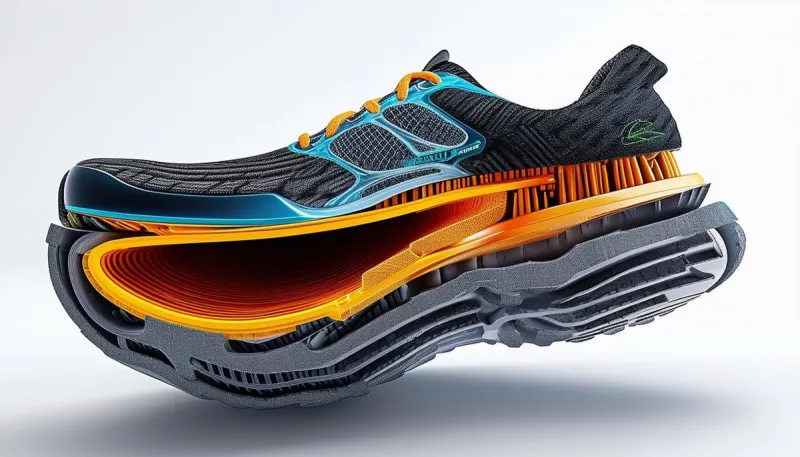
Photo: shoe technology cross section cushioning midsole lab testing close up, via buyreviewer.com
Walk into any athletic or lifestyle shoe retailer in the US right now and you'll be hit with a wall of buzzwords. Carbon fiber plates. Nitrogen-infused foam. Ortholite insoles. Responsive midsoles. It sounds impressive — and honestly, some of it genuinely is. But a lot of it is also carefully engineered marketing designed to make you feel like you need a PhD just to buy a pair of sneakers.
So what's real? We went deep on the science, pulled in perspectives from podiatrists and biomechanics researchers, and tested the claims against what everyday wearers actually experience. Here's what the footwear lab doesn't always tell you.
The Cushioning Conversation: Soft Isn't Always Better
For decades, the assumption was simple: more cushioning equals less impact equals happier joints. Brands piled on foam, gel, and air pockets, and consumers bought in. But the science has gotten more complicated.
Dr. Emily Hartwell, a sports podiatrist based in Portland, Oregon, puts it plainly: "Cushioning changes how impact is distributed, but it doesn't eliminate it. Your body is actually pretty good at self-regulating ground reaction force — which means ultra-plush shoes can sometimes cause people to strike the ground harder, not softer."
This phenomenon, sometimes called the 'cushioning paradox,' has been documented in biomechanics research going back to the 1990s. Your nervous system reads the ground through your feet. When it senses a soft surface, it often compensates by landing with more force.
That said, cushioning still matters — especially for people who are on hard surfaces all day, like nurses, retail workers, or warehouse staff. The key is finding a balance between responsiveness and protection. A shoe that feels like a cloud under your heel isn't always the one that's doing the most work for your body.
Bottom line: Don't chase maximum softness. Look for cushioning that feels responsive — you should feel the ground a little, not float above it.
Arch Support: Who Actually Needs It?
This one is genuinely complicated, and the footwear industry has not always been honest about it.
Arch support is legitimately helpful for people with flat feet, plantar fasciitis, or specific structural issues in the foot. For those folks, a well-designed medial post or contoured footbed can meaningfully reduce strain on the plantar fascia and Achilles tendon. Studies published in journals like the Journal of Foot and Ankle Research have confirmed real, measurable benefits for these populations.
But here's the thing — most people with neutral arches don't need aggressive arch support built into their everyday shoes. In fact, some biomechanists argue that over-relying on built-in support can weaken the intrinsic muscles of the foot over time, similar to how wearing a brace too long can cause muscle atrophy.
"I always tell patients to think of arch support as a tool, not a lifestyle," says Dr. Marcus Webb, a certified pedorthist in Chicago. "If you have a specific condition, absolutely use it. But if you're buying arch support shoes because you think they're universally healthier, that's not necessarily backed by the evidence."
Bottom line: Get your gait assessed if you're having pain. Don't buy into the idea that maximum support is always better — it depends entirely on your foot structure.
Energy Return: The Carbon Fiber Plate Debate
This is where things get genuinely exciting — and where the marketing hype is also at its most aggressive.
Carbon fiber plates embedded in midsoles became mainstream after Nike's Vaporfly line started dominating marathon times. The science is real: a stiff carbon plate works like a spring, storing energy during the loading phase of your stride and releasing it during toe-off. Studies have shown efficiency gains of around 4% for elite runners — which is enormous at that level.
For everyday wearers, though, the story is different. That 4% figure comes from research on trained runners with efficient biomechanics. Recreational walkers and casual joggers don't have the stride mechanics to fully exploit the plate's spring effect. You might feel snappier in them, but you're probably not getting the same measurable return on investment.
That said, some people do report genuine comfort benefits from the added stiffness, particularly those with forefoot pain or conditions like Morton's neuroma. The rigidity reduces the amount of bending stress at the ball of the foot, which can be a real relief.
Bottom line: Carbon plate tech is genuinely innovative, but it's optimized for performance athletes. If you're not logging serious miles, the $200+ premium may not translate to real-world benefits.
Moisture-Wicking and Breathability: Actually Worth It
Here's one area where the technology consistently delivers. Modern mesh uppers and moisture-wicking linings genuinely do a better job of managing sweat and heat than traditional leather or canvas. For anyone living in humid climates — think Houston, Miami, or Atlanta — breathable uppers aren't a luxury, they're a quality-of-life upgrade.
Engineered knit materials like Flyknit and Primeknit have also gotten remarkably good at combining breathability with structure. They conform to the foot, reduce hot spots and pressure points, and dry faster after exposure to moisture. If you're on your feet for long stretches or exercising in warm conditions, this stuff genuinely matters.
Bottom line: Breathable uppers are one of the most consistent, real-world-proven innovations in modern footwear. Don't overlook them.
How to Shop Smarter Without Getting Played
So how do you cut through the noise? A few practical rules:
- Test before you commit. No amount of spec sheets replaces 10 minutes walking around a store. Your body knows.
- Match the tech to your actual life. A carbon plate road racing shoe is not the right call for a teacher who stands on tile floors all day.
- Invest in fit first. The most advanced cushioning system in the world won't help if the shoe doesn't fit your foot shape correctly.
- Talk to a professional if you have pain. A podiatrist can give you personalized guidance that no product page can.
- Be skeptical of proprietary names. 'CloudFoam' and 'Boost' and 'React' are brand names for foam formulations. The underlying materials often share more similarities than differences.
Every step you take leaves an impression — on your body, your posture, and your long-term joint health. The right shoe technology, matched to the right person, can genuinely make a difference. But the best shoe for you isn't necessarily the one with the longest list of features. It's the one that works with how your body actually moves through the world.